
Artificial intelligence, now simply referred to as AI, is a recent technological phenomenon still in its infancy, but it won't be long before every aspect of human civilization, and all of its endeavours on this planet, will be under its influence. Considerations regarding its usefulness or harm are ongoing, but the unintended consequences of its long term use are likely well beyond the capability of natural-intelligence to comprehend. AI is now often used to generate various forms of new content, by harvesting pre-existing media or data, and it is now pervasive online in the form of chatbots, or is directly embedded within the search functions of internet browsers, even on tiny cell phones.
AI has also demonstrated a remarkable ability to facilitate language translation. This technology now enables curious members of the general public to penetrate linguistic barriers in their search for foreign language content, which had otherwise been typically only available to scholarly researchers with professional human translators at their disposal.
The AI-assisted Russian translations of historical writings posted on this web site, were facilitated by the use of DeepSeek R1, a recent Chinese chatbot, that had taken the North American AI industry by storm in January 2025. The AI model was founded in 2023 by Liang Wenfeng, a young Chinese university graduate in electronic engineering, who later while managing an AI-driven hedge fund, earned a small fortune and then diverted his attention and funds to the development of the open-source DeepSeek model, for a fraction of the cost of existing models. He then made it freely available to others.
About this web page ... the following page content will describe my personal interactions with the DeepSeek interface to translate the writings of four historic scholars, three Russian and one Prussian/German, who studied religious dissidents and sectarians in the 18th and 19th centuries of the Russian Empire. This exercise on my part, was an experiment to learn and test the DeepSeek AI translation process itself, and its capability to do so. The actual significance and content of the writings themselves was in essence somewhat secondary. That's of course not to say, that the resulting English translations as posted here, may in themselves actually be of greater Doukhobor interest to others, than the process of their translation. The writings do after all offer insights into the origins of the Doukhobor faith and their ancestral history particularly in South Russia and the "Milky Waters" region of the Crimea.
About the DeepSeek chatbot process ...
For those unfamiliar with the DeepSeek chatbot interface and translation process, what follows is an explanation of my interaction with the "entity" in question.
Most internet users likely first experienced online translation using Google Translate, which is, essentially a search blank, where one can type a passage in need of translation. The passage can also be uploaded as a text file. The resulting translation then appears shortly thereafter alongside the original, to its right, which could then be copied and pasted elsewhere. The DeepSeek chatbot is much the same. The file upload would preferably be a pdf file that had been previously OCRd, that is, been made searchable, by first converting a picture file, such as a jpg photograph, to literal text.
OCR, the short three letter acronym for Optical Character Recognition, was introduced by an American computer scientist, inventor and futurist, Ray Kurtzweil, in the late 1970s. He developed software with the capability to optically recognize patterns on printed pages that looked like shapes of letters, in itself perhaps a form of perceptual intelligence. Once the software recognizes or identifies the odd shapes as characters or letters of the alphabet, it then harnesses the context of language, its vocabulary, to perceive the characters as words, sentences and meaningful text. The resulting text could then be copied and pasted into other word processing software. I use Adobe Acrobat Pro 9, part of my old CS4 Photoshop suite, for OCR, importing pictures of pages, typically jpgs, as sources for character recognition. AI-assisted versions of OCR software are also now available, which rely on a wider library of foreign languages, and make use of AI-driven context to recognize words more accurately.
An Adobe software engineer, John Warnock, developed the next stage of this remarkable process in the early 1990s, inventing a page viewing and printing media format called Pdf or "Portable Document Format". This file format is universally readable by various different computer apps and platforms, and is very widely used in different languages across the world today. Adobe Acrobat Pro is able to manipulate large pdf files, easily rearranging, deleting, cropping or extracting only certain pages, and so forth. There are essentially two types of pdf files, those that are already searchable, having been OCRd into text, and those that are not. Searchable pdf files will have two layers, the top layer would be the picture layer, the lower layer would be the text layer, generally invisible to viewers.
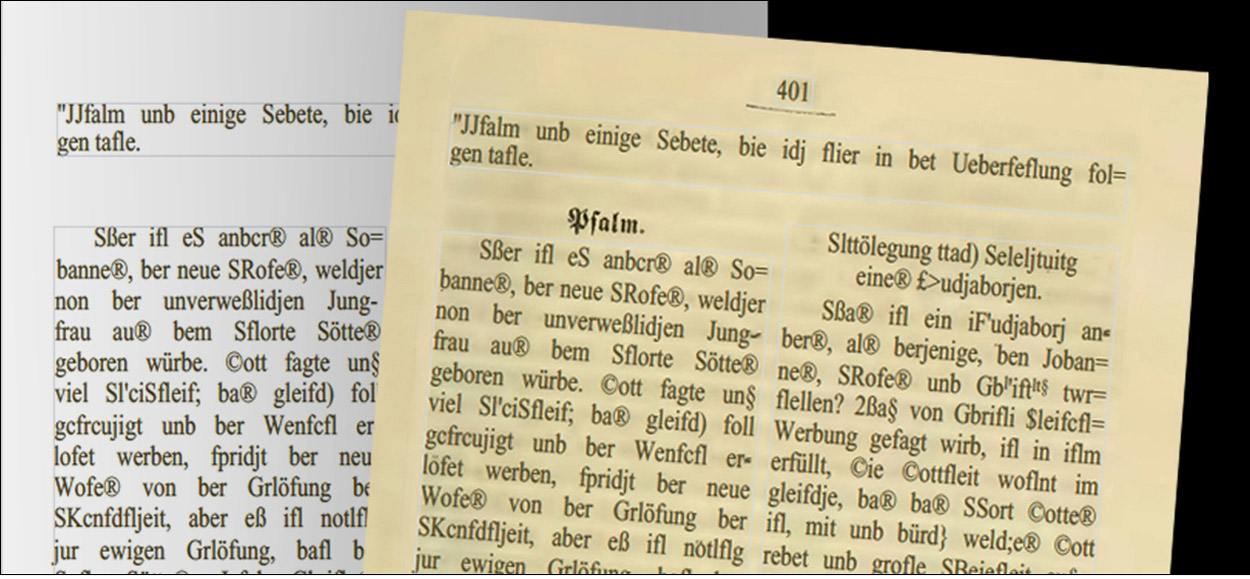
The above graphic depicts both Pdf layers, the top page layer is a picture, and the lower layer depicts the OCRd text, here slightly moved aside. If the picture layer had been blurry or damaged to start with, the recognized character lower layer, and thereby the searchable text, would be garbled or faulty. In this example the OCR has been near perfect, the German characters were recognized very nicely, although the page number was oddly missing. On viewing this pdf, and highlighting the page number "401", a copy and paste would not be successful.
Page by page pdf uploads are simple enough, but my first attempt at the translation of Novitsky's 1882 volume in bulk form, elicited a courteous response from DeepSeek, that it could only handle about 80 percent of the volume at one time, and encouraged an upload in four sections. I used Acrobat Pro once again, to accomplish this, then proceeded with the upload. In my experience, it appears that the DeepSeek chatbot is unique among others, in the sense that as it initiates a response, it first articulates its understanding of the request or prompt, then step by step, it reveals its intelligence, confronting challenges it will encounter, and even listing sources it will contemplate. This process happens in seconds, the final translation itself then appearing smoothly and rapidly line by line in front of one's very eyes. The Novitsky 2nd Volume, in 4 parts, was translated in about 20 minutes, and the results were nothing short of extraordinary. In my casual appraisal, the translation did not require a single word edit. Minor footnote placement errors did occur, as did pagination, as Russian language translations do appear to require considerably more real estate in print.
A transcript of an actual real-time exchange with DeepSeek can perhaps best describe the process. The DeepSeek prompt requested the translation of an uploaded German version of a traditional Doukhobor psalm, "Духоборец тот", as depicted above, from German to Russian, then English. (Link)
The Russian Empire - brief historical context
Briefly evaluating the Novitsky and Livanov translations to make sense of their scope and content, it became clear that at least a rudimentary preliminary understanding of the history and geographical disposition of the Russian Empire would be helpful to better understand their historical context. The Russian theological scholars researched and published their work in the mid to later 1800s, and their focus on Doukhobors would understandably have been on their earlier origins throughout South Russia and the Crimea rather than their later history in the Caucasus. And not particularly familiar with the geopolitical landscape of the empire at the time, I adapted an existing map from an online historical atlas to visualize the regions referenced in their writings. Doukhobor settlement locations on this map were colourized, with the darker colours indicating the more populated provinces (guberniyas). The darkest marking identifies the Taurida (Tavria) Guberniya at the Sea of Azov, where the mass settlement of Doukhobors occurred after 1802 on the west riverbank of the Molochnaya (Milky) River. The settlement itself then in translation, became known as the Milky Waters colony.
Subsequent paragraphs, maps and graphics in this web page segment, aside from this map, will summarize my homespun version of general Russian history, essentially prior to the settlement of Milky Waters.
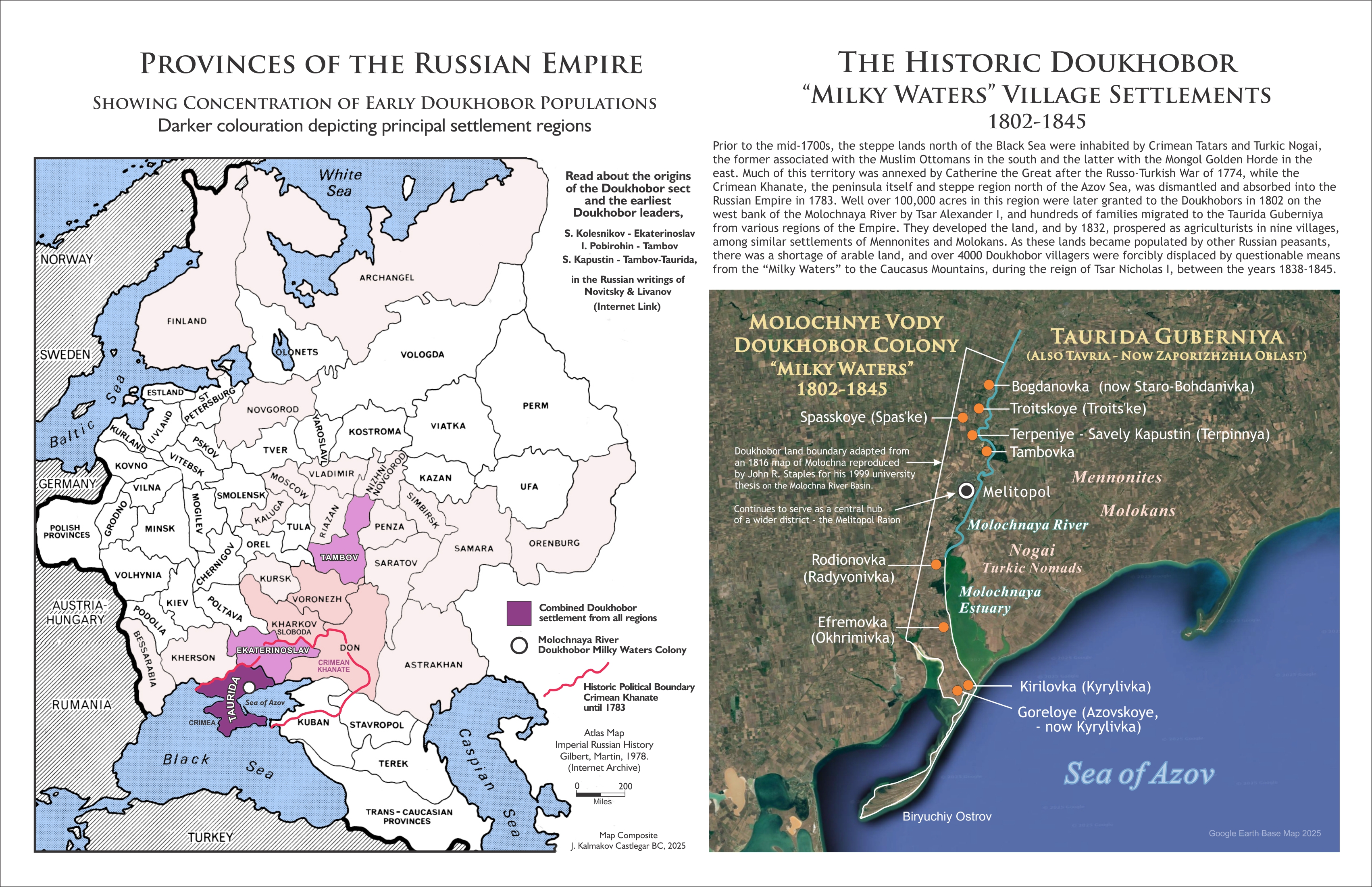
The historical geography of Tsarist Russia and the Empire
At the crossroads between ancient civilizations, this part of the world had been contested by many rulers and empires ever since the early Greco-Roman era. In the middle of the middle-ages, Genghis Khan's grandson extended the Mongolian Empire this far into eastern Europe, invading the ancient lands of what is now modern Russia, Ukraine, Poland and Hungary. While the Mongol forces turned back, their former territory and administrative influence remained in the west for centuries as the Golden Horde. (Link) The territory surrounding the Molochnaya River basin, was occupied by the nomadic Nogai people, who in time adopted Islam and Turkic culture.
When Russia coalesced in the west as a centralized Tsardom in the 1550s, it too was preoccupied with territorial expansion. It however looked eastward in reverse, invading and hoping to Russify the former Mongol successor "Khanate" states. The strategy was to populate the uncultivated grasslands with sedentary agriculturalists, who would stay rooted to the ground rather than migrate back and forth across the inland steppe as nomadic herdsmen.
Russia actually became an Empire only during the reign of Peter the Great in 1721. A visionary Romanov, he adopted Western European ideas and expertise to modernize Russian industry, and the military, while also introducing reforms to educate and "enlighten" civic society. As Russia attained status as a powerful European state, he solidified his administrative control over the empire, by secularizing the Orthodox church, in essence as a department of government, and consolidating numerous previously segregated odd-sized uyezds or city regions into eight uniformly sized large Governorates; Moscow, Ingermanland, Kiev, Smolensk, Archangelgorod, Kazan, Azov, and Siberia. (Link) To the chagrin of local society, he also moved the capital city of the empire to the Baltics, after the defeat of Sweden in military conflict, naming it St. Petersburg.
In 1745, a Prussian princess married Peter III, the grandson of Peter the Great, and shortly thereafter deposed him from the throne, to become the third Empress of Russia, as Catherine II. She adopted the enlightened policies of Peter the Great, and was seemingly thereby also referred to as Catherine the Great, turning out to be equally ambitious. In 1762, Catherine II advanced the earlier initiatives of Peter the Great's daughter, Empress Elizabeth I, to promote the agricultural settlement of the southern regions of the Russian Empire. She enticed potential newcomers with various incentives in the form of written Manifestos, in various languages, offering them free land, freedom from paying taxes for a period of time, religious freedom and exemption from military service. These manifestos initially led to significant German settlement in Russia, particularly along the Volga River, but they also foreshadowed similar incentives and concessions to be given Doukhobors by her grandson, Alexander I, a few decades later.

Catherine's attitude regarding the occupants of the Crimean Khanate at the Black Sea and the Sea of Azov, (Link) was however quite different. The steppe lands here at that time were part of the Ottoman Empire, and the Crimean Khanate was a vassal state, although it was given a certain degree of independence, due to a curious relationship with the Ottoman empire. Its militant
Tatar
Catherine wrested these southern lands from the Ottomans in the Russo-Turkish War of 1768-74, and put a stop to this troublesome enterprise by simply absorbing the Crimean Khanate into the Empire. For fine tuning jurisdictional control over her expanded territories, she revised Peter the Great's map of the Russian Empire, into twenty provincial Governorates (Guberniyas), as depicted here on this web page map. (Map)
Mennonites
The former Crimean Khanate steppe lands had fertile soils and a climate suitable for agriculture, and the empress sent emissaries to invite the Prussian Mennonites to settle there in 1788. Proven agriculturalists, they were also pacifists, and by coincidence were just then being subjected to military conscription, and welcomed the opportunity to emigrate. They however astutely formulated a listing of pre-conditions, or concessions from the Tsarist state, prior to their immigration, assuring that they would be guaranteed. The listing of concessions, later called a "privilegium", went even beyond those offered immigrants in Catherine's Manifestos.
The Prussian Mennonites settled in two large colonies in South Russia. From 1788 to 1796 approximately 350 families first settled in Chortitza, north of the Molochnaya, and another remaining Prussian group migrated to the Taurida (Tavria) Guberniya and settled on the east bank of the Molochnaya River in 1803. Here they found that a settlement of like-minded Doukhobors had already been in progress on the opposite side of the river since 1802.
The Doukhobors
The origins of the Doukhobor movement in the Russian Tsarist midst were somewhat vague, as they themselves were by and large illiterate and did not leave a written record of their early history, although the tenets of their faith seemingly emerged and crystallized in disparate regions. From the standpoint of the established Orthodox church, their beliefs were nonetheless all considered heresies and members of the sect were persecuted throughout the 18th century, when suspected or found guilty of proselytizing, or influencing others to stray away from Orthodoxy. The Orthodox peasantry at large, likewise mistrusted Doukhobors as neighbours, and harassed them at will.
Catherine the Great died in 1796, and her grandson, Tsar Alexander I, understood this, and sympathetic to the notion of mutual-coexistence in the empire, set aside almost a 100 thousand acres of vacant Molochnaya River steppe lands in 1802 as a safe haven or refuge for the Doukhobors north of the Sea of Azov. Unlike the Mennonites, the Doukhobors do not appear to have prepared self-proclaimed written listings of desired or expected concessions, although Alexander's edict, did certainly specify certain favourable terms of settlement.
Interestingly, the Russian Mennonite settlement of the Canadian prairies in Manitoba in the 1870s, followed a similar pattern of immigration, whereby they pre-arranged a formal written listing of concessions, including exemption from military service, to be confirmed prior to their arrival. The well documented Canadian government Hamlet Clause in the Immigration Act, was indeed also enacted as a concession to permit their form of collective homestead settlement and cultivation. The Mennonites in that sense paved the way for the later Doukhobor entry into Canada in 1899.
Here in the Crimea, families from different provinces sought permission to settle in the Taurida (Tavria) Guberniya after 1802, and their Molochnaya River community became known as the Milky Waters colony, the first consolidated mass settlement of Doukhobors in their Russian history. The immigrants first settled in the villages of Bogdanovka and Terpenie on the west riverbank, near the city and region of Melitopol. Ironically and sadly, this is the very site of the current military conflict (in 2025) between modern Russia and Ukraine.
In the Milky Waters, the Doukhobors co-existed largely on friendly terms with the Mennonites, the Molokans, the indigenous Nogai, and the Orthodox peasantry, until their forced exile to the Caucasus between the years 1838 and 1845.
About the writers ...
The chronology of the Russian writings translated and posted on this website is significant, as the authors of these works cross-referenced one another to some extent over time. Also it is important to recognize that Novitsky and Livanov, as theological scholars, were trained in Russian Orthodox seminaries, and Doukhoborism was considered a heresy by the church throughout the 18th and 19th centuries. But although they identified certain heresies of interest, their writings nonetheless offered detailed insights into early Doukhobor history beyond just matters of religious faith. The writings of Bonch Bruyevich were published a few decades later, when Russian circumstances had dramatically changed, and as such, he stands apart from the others in numerous ways.
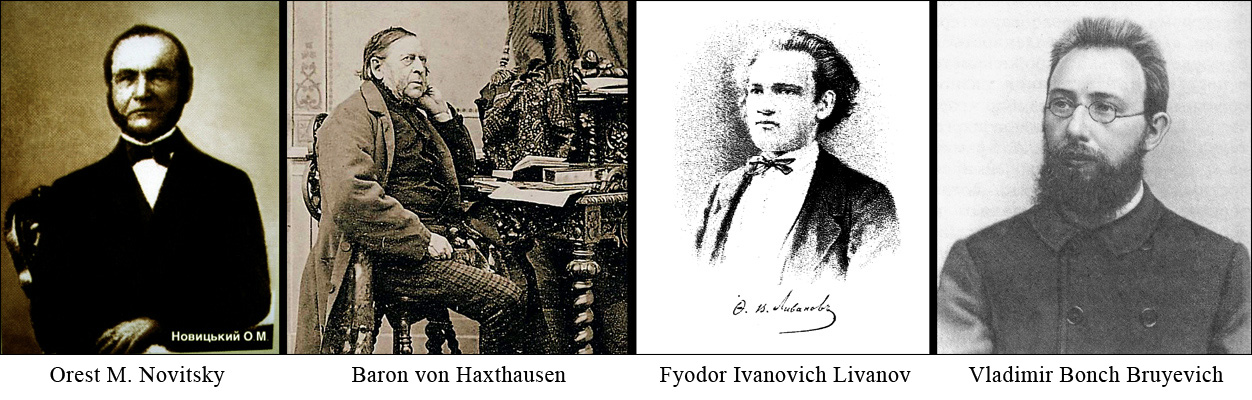
Orest Novitsky was first ... He studied as a young man at the Kiev Theological Academy, where he wrote his master’s thesis “On the Dukhobortsy” in 1832, and it appears to have been printed internally in a publication called, “Experiments of students of the Kiev Theological Academy of the fifth year” (Zhan, S. 2016). (Link) This was thought by modern researchers to be the first serious study of the beliefs, life and customs of the Doukhobors. Novitsky was also interested in philosophy in general, and the relationship between reason and faith. He later taught at the same Academy that he attended, as well as the Taras Shevchenko National University of Kyiv, where he was a professor of psychology, writing the first Ukrainian textbook on that subject in 1840. Fifty years after his first thesis on the Doukhobors, he followed it up with an updated version, Edition II, in 1882, incorporating the research and studies of Haxthausen and Livanov. (Link)
Interestingly, in the course of the translation of Volume II, DeepSeek clarified that it had indeed already been translated to English at one time, by John Woodsworth, published in 1982, by Slavica Publishers, (Indiana University) as part of their series on Russian and Ukrainian religious dissenters. The book however was long out of print and difficult to access, and in that respect, it appeared that another translation may have been justified.
Haxthausen was next ... A highly educated German nobleman and a Catholic conservative, he was distinguished in public life, and integrated in the local cultural community as a writer. Also an agricultural expert and advisor to the Prussian government, he became disillusioned with the inequities of society, particularly at the expense of the local German Slavic peasantry. Studying land tenure across Prussia, he came to the conclusion that the peasant agricultural system of land management may have been an ideal model for general social harmony, although it appeared to be threatened by emerging industrialism and the western liberal enlightenment. When the ideas he advocated were not embraced at home, he looked eastward to Russia in 1843 in support of his hypothesis, to study its peasant mir communal system of land use and tenure.
Emperor Nicholas I paid him a total of 11,232 roubles in the 1840s to study and write a report on the Russian rural agricultural landscape and its land tenure. Prince Paul Lieven (nephew of the former Ambassador in this country) facilitated the arrangements for an expedition into the interior, preparing for his benefit a 7000 mile itinerary and a coach with coachmen for the journey. Over a period of six months, he toured European Russia, the Caucasus and the Crimea, interviewing peasants, Orthodox priests, landlords and officials, taking a special liking to Old Believers and the formerly German, Mennonites in particular.
On his return west, according to an article by S.F. Starr, Haxthausen published the results of his work first in German: Studien uber die inneren Zustande, das Volksleben, und insbesonders die landlichen Einrichtungen Russlands, Vols I and II, Hannover, 1847; Vol III, Berlin, 1852, then as an authorised French translation: Etudes sur la situation intlrieure, la vie nationale et les institutions rurales de la Russie, Vols I and II, Hannover, 1848, Vol III, Berlin, 1853. And an English abridged version: The Russian Empire, Its People, Institutions and Resources, 2 Vols, London, 1856, was later published by Robert Farie in 1856. Two Russian translations were also attempted, a partial translation by L. I. Ragozin, also in 1856, and a more expanded version, "Russia: Popular Institutions, Daily Life, and Agriculture", published in 1870.
Haxthausen also supplemented his astute observations with a fair number of remarkable drawings. Using pen and ink on his journey, he illustrated a visit to a village of Old Believers in the Great Igris (River) en route to the Crimea, where he was greeted "in accordance with an Eastern and ancient Russian custom - with bread and salt, symbols of heartfelt hospitality."
 This drawing only appeared in the French and German editions, and from a comparison with an online portrait of the Baron, it appears that he may have actually penned his own likeness in this image, standing in the midst of a bearded gathering of old traditionalists (non-Doukhobors) receiving their token of hospitality. Unverified within his own text or elsewhere as a self-portrait, we can perhaps only assume that it was.
On visiting the Crimean Mennonite colony on the east bank of the Molochnaya River near the Sea of Azov, in July, 1843, Haxthausen was escorted across the river to the Doukhobor village of Terpenie by the Mennonite leader, Johann Cornies. (Link) Observing his surroundings, he produced an even more remarkable drawing, depicting Saveli Kapustin's Sirotskoe residence and village compound. His drawing depicted below, was extracted from the German version of the book, alongside a second simple plan view of the site from an adjacent page.

Tainted legacies
There's no question that we can learn a great deal about the Russian Empire and the early history of the Doukhobors from the writings of August Haxthausen, but the writings also unfortunately revealed a significant lapse in his personal good judgement. His literary legacy as a result perpetuated what turned out to be a questionable account of Doukhobor occurrences and circumstances at Terpenie, learned from his 1843 visit to Saveli Kapustin's Sirotskoe residence. There were rumours before that time after the death of Kapustin, that subsequent leaders had perpetrated horrendous criminal misdeeds. Witness after witness brought suspect accusations against them to the attention of local government officials, and there were resulting interrogations, arrests and court proceedings. But there may also have been other reasons for their discontent. By the 1820s, as the Doukhobor Molochnaya settlements prospered, nearby Orthodox peasants and other landholders, felt that the Doukhobor villagers were greedily and unfairly acquiring vacant steppe lands, while they were becoming increasingly in short supply. And the accusations could conceivably have been fabricated as a means to demonize the Doukhobors. Ultimately Tsar Nicholas I himself was convinced to weigh in on this matter, and by special decree, he forcibly displaced some 4000 Doukhobors from their prosperous Milky Water lands to the remote and desolate Caucasus mountains.
Haxthausen had then been escorted to Terpenie, just as the last villagers were being displaced from their homes. His tour guide, Johann Cornies had at times spoken kindly of the Doukhobors, and they had in turn benefitted greatly from the expertise of the Mennonite community, but on this occasion he appears to have brought their supposed misdeeds to his attention. Haxthausen's written account of his story then reverberated in the later written works of Novitsky, Livanov and others, who referenced his words and even quoted lengthy passages. The historical record of the Milky Waters settlement thus remained tainted for almost a century until the more reliable "facts" of the case finally came to light in 1999, in a doctoral thesis by John R. Staples. (Source) Or only relevant pages here. (pdf) He suggests that Johann Cornies and his brother, were not particularly distraught about the displacement of the Doukhobors, as they appeared to have gained more than others from access to their vacated agricultural lands.
Then came Livanov ... Feodor Vasilievich Livanov acquired a doctorate in theology from the Imperial Saint Petersburg Academy of Sciences and was later a professor of comparative religion at a St. Petersburg university. Himself a member of the Russian Orthodox Church, he used his institutional resources over the years to research Russian dissenters and sectarians, publishing his findings in four volumes between the years 1869 and 1873, with additional editions interposed within the four. Like the Novitsky writings, Livanov's works can be found today in various online archives.
Only certain chapters of interest were selected for translation, the Doukhobor content frequently associated with that of the Molokans, the two having common ancestral leadership roots. Russian language readers interested in other chapters within the chosen volumes, may find a complete listing of tables of content here. (Link) What is a little frustrating about the editions, is that certain chapters within them, were simply duplicates.
Livanov titled his writings, "Raskol’niki i ostrozhniki: Ocherki i rasskazy", or in translation, "Schismatics and Prisoners: Essays and Stories". Looking at the content of his writings, it would seem that it could have been translated slightly differently. The term "Prisoners" may have instead, just as well been, "Sectarians" to differentiate it from "Schismatics". Sectarians, like the Doukhobors, were separating from Orthodoxy, while the Raskol’niki or Schismatics, such as the Old Believers, were dissenting, but still within the realm of the Orthodox church.
Vladimir Bonch Bruyevich (Bruevich) ...
Russian translations ... Bonch Bruyevich (1873-1955) was a complex and somewhat enigmatic historical figure, and an outsider on this web page, as his writings were published largely in the early 20th century. He was relatively unknown by Doukhobors until 1899, when he and Vera Mikhailovna Velichkina, a young doctor, accompanied them on their last voyage from the Caucasus to Canada. Concerned about the welfare of the impoverished immigrants, left on their own resources to begin a new life on the remote Canadian prairies, they stayed several months living among them. A highly educated 26 year old, he was already interested in Russian peasant sectarians, their religious faith, and folklore, and he took advantage of their prairie experiences to document the traditions and religious psalms of the Doukhobor villagers. Previously never seen in print, they had until that time for at least a century, been preserved only in their living memories, passed along from generation to generation.
Back in Russia in 1909, he then compiled and published the collection of hymns and psalms acquired on the Canadian prairies, in a 330 page volume, titled "Zhivotnaya Kiniga" or "Living Book". The English translation of the lengthy introduction to this book is posted here online, (Link) while the psalms themselves in this volume, remain in their native Russian language. Two examples of some historical interest, were however selected for translation, Psalm 144, and a "Разсказъ" (story) by Peter V. Verigin. (Link) These were identified by the Doukhobors themselves in 1899, when questioned by Bonch Bruyevich in Canada, as to "which psalms from the entire "Book of Life" they (would) consider the most important, clearly expressing their worldview". Also of interest, Livanov himself had in his 1870 exposition on Doukhobor Doctrines and Rituals, described a "Living Book". (Link) "This tradition is called the 'Living Book'— a book alive in the memory and hearts of the Doukhobors, in contrast to the Bible, which, they say, is contained in dead letters."
Bonch Bruyevich finally published his account of his voyage to Canada and the prairies almost two decades later in 1918, and its English translation, possibly never attempted previously elsewhere, is included in this online collection. (Link)
Wikipedians now characterize Vladimir Bonch Bruyevich as a Soviet politician, revolutionary, Old Bolshevik, and Vladimir Lenin's personal secretary. And with these credentials, it doesn't appear that he was as much a theological scholar as were the other writers. Which then raises the question ... why was he interested in Doukhobor pacifists?
As a Marxist and social activist ... Current writers and scholars reveal that Bonch Bruyevich had acquired anti Tsarist sentiments even at the age of 19, fascinated by historic Russian insurrectionist movements such as Stenka Razin's peasant rebellion, and the later "Narodniks" who perceived the peasantry as a revolutionary tool to overthrow the Tsarist government. Bonch Bruyevich later embraced and expressed these sentiments as a student attending a surveying technical school, and expelled for orchestrating a student protest, he became involved in the political Social Democratic movement itself in 1892. While there was considerable unrest at that time among the industrial working class of Tsarist Russia, western Europe had been the original fertile ground for the growth of Marxist socialist ideology. It's unclear why Bonch Bruyevich actually emigrated west to Switzerland in 1896. It may have been a desire to pursue these socialist anti-Tsarist sentiments, or perhaps as it's been documented, to attend university. Or it may indeed have simultaneously been both. Vera M. Velichkina was also there, and the two were later destined to share common life experiences for years to come.
Read a two page entry about Vera Velichkina and her siblings found online in a historic Russian dictionary of revolutionaries, (as an AI English translation): "Bio-Bibliographical Dictionary of Figures of the Revolutionary Movement". (Link) Read the English translation of Vera Mikhailovna's own account of her personal relief work with Leo Tolstoy during the widespread Russian famine of 1892. (Link)
While abroad, Vladimir Bonch Bruyevich soon joined local revolutionary circles, and embarked on his career as an "influencer", acquiring printing presses, writing articles and preparing promotional leaflets. Russian activist Vladimir Lenin also returned to western Europe after Siberian exile, encouraging local enthusiasm for political dissent, and if need be, even Russian revolution. Bonch Bruyevich is thought to have originated Lenin's propaganda newsletter, Iskra, to which he also contributed articles. And copies of the newsletter were then also smuggled into Russia to foment worker dissatisfaction with their abusive working conditions and poverty-level wages imposed upon them by industrial capitalists. To bring the Iskra paper closer to home, Bruyevich was said to have even facilitated the smuggling of printing presses into Russia itself. And interestingly, one may have arrived in Baku for placement in a basement print shop, for the use of Lado Ketskhoveli and Iosif Jugashvili (Joseph Stalin) who were advocating economic justice for the overworked and underpaid oil workers in the Caucasus. (Link)
As a Doukhobor folklorist and social researcher ... In the meantime at the seaport of Batoum, on the eastern shores of the Black Sea in the Caucasus, Doukhobors were embarking on British steamships to Canada, finally given freedom from relentless persecution by the Russian imperial government. Bonch Bruyevich was familiar with the Doukhobors, and both he and Doctor Velichkina had also met Leo Tolstoy and seemingly likewise knew his followers, the Chertkovs in the mid 1990s. As Russian expatriates, the Chertkovs were then living in England, in contact with the British Quaker Society of Friends, and at their request, Bonch Bruyevich accompanied the final voyage of the Doukhobor emigrants to Canada in the spring of 1899.
He was accompanied by Doctor Velichkina herself and they both remained in Canada for nine months. A house and hospital had already been awaiting them in the village of Mikhaelovo in the distant north colony, and while the doctor maintained the makeshift hospital for the care of the Doukhobors, Bonch Bruyevich toured multiple villages in the remote wilderness interviewing Doukhobor elders about their psalms, and transcribing their oral history, their "Living Book", into what would become the printed "dead letter" of the "Living Book". The two were married on their return to Switzerland, and Vera Mikhaelovna published her remarkable account of their fourth voyage in 1900, (reproduced in the English language in 1999 in the book: (Link) Russian Roots and Canadian Wings: Russian Archival Documents on the Doukhobor Emigration to Canada), while Bonch Bruyevich collected additional first hand source documents on Russian sectarians and published the results in six editions of "Materialy k istorii i izucheniiu russkago sektantstva i raskola", in 1908. (Link) Then preoccupied with other matters, functioning as a confidant for Lenin, and a bureaucrat and commentator for the Soviets after the 1917 revolution, he remained an expert and advisor on sectarians, and finally published his own account of his Canadian journey in 1918. Its translated form has now in 2025, been finally posted here. (Link) This book is historically significant because it reveals that Bonch Bruyevich's interest in the Doukhobor prairie settlement went beyond just their recital of psalms. He was in fact documenting all aspects of the Doukhobors sect, including their folklore, as observed in person in 1899, just as they were planting their very first Canadian "grass roots".
The details of the Russian revolutionary history up to the October Revolution of 1917, and its aftermath into the 1920s and 1930s, and the Stalinist years, are far, far, beyond the scope of this web page and admittedly this writer's comprehension. But in a broad sense, it is generally understood that the discontent of the Russian population with the Tsarist regime, prior to the Revolution had been expressed by both the working industrial class, the so called proletariat, and the peasant class, the agrarians. Serfdom had been abolished in Russia in 1861, yet the peasantry, which constituted a majority of the population, was still disadvantaged institutionally, and there continued to be peasant uprisings across the empire.
Bruyevich understood this, and while he expressed an interest and compassion for the plight of the Doukhobors, he also likely looked at this opportunity with them as a sort of field study to determine if there may have been an underlying strength in peasant movements such as these, especially those of sectarians with strong commitment to their principles, to mobilize collective protest against the autocracy of the Tsarist state.
Robert B. Klymas, a respected Canadian scholar and writer, describes this notion in his 1980 article, "V. D. Bonch-Bruevich and the Lenin Connection":
"Keenly aware of Russia's perennially sensitive peasant problem, he took an early interest in Russian sectarianism and studied the writings of Marx, Engels, Lenin, and others. Lenin in particular had noted how, in the past, religious heresies were the seeds of political revolutionary change, and how there appeared to be a universal connection between political protest and the spread of sectarianism among the peasant masses. Bruevich committed much of his energy to a long term search for publishable materials that could underline aspects of social protest that simmered among the tensed up masses of Imperialist Tsarist Russia before the Revolution. After all, if Russian sectarianism was indeed a powerful but latent tool waiting to be wielded in the cause of communism and the coming revolution, it was necessary to harness this potential; and what better way for the young Bruevich to do this than to study and if politically expedient, even to encourage the spread of sectarianism in prerevolutionary tsarist Russia. Moreover, was there not a crying need to immerse oneself in the problem in order to have a true glimpse of how Russia's sects operated, how they transmitted their teachings, customs, and beliefs?"
Baron Haxthausen, the German agricultural economist, likewise studied and celebrated the potential of the peasant agrarian commune system, but it is telling that even as his work was being published in German, French and later English in the late 1840s, it was initially prevented from publication in Russia, out of concern for its potential to inspire antagonistic socio-political repercussions, which in essence it did. Serfdom was abandoned in Tsarist Russia not long afterwards by Alexander II in 1861.